Friday, March 21, 2014

Heading for Jorupe

Deciduous dry forest, Tumbesian style, at Jorupe Reserve
(Photos by Narca)

Jorupe Reserve in extreme southwestern Ecuador is only a stone's throw from Peru. One of the reserves under the aegis of the Jocotoco Foundation, Jorupe protects tropical deciduous forest, a habitat that has nearly vanished. Only about 1% of Ecuador's tropical dry forest remains intact.

The reserve is tiny (only about 2 square miles) but very important, protecting an endemic-rich habitat only found here and in neighboring northwestern Peru: the Tumbesian region. I find differing reports on the number of globally-threatened birds that occur in Jorupe, but it's about 20 species.

The reserve's boundaries are all too clear

The Jocotoco Foundation has its sights set on expanding the reserve a modest amount, and on regenerating degraded habitat within the reserve. Tropical dry forest can be more easily regenerated than tropical rainforest, as long as the seed bank is intact and the soils haven't completely washed away. (The regeneration of tropical dry forest was first demonstrated in northwestern Costa Rica.)

Recovery of degraded lands around Jorupe is being achieved through an ambitious project of revegetation. Within a 5-year period, more than 110,000 new trees have been planted.

Two of Jorupe's characteristic trees are these:

A muscular and much-admired ceiba tree, Ceiba trichistandra

Cecropia trees as a group are distinctive. There are more than 60 species of cecropias, and the northern Andes Mountains are the center for their diversity and evolution. Fast-growing, many of them pioneer both natural and man-made gaps within neotropical forests. Their fruits are highly sought by birds. Many of them harbor Azteca ants, which protect their host cecropia from herbivores.

A species of silver-leaved cecropia

Community outreach is part of the conservation effort at Jorupe, and it's winning staunch supporters among the local people. Ecotourism is also benefitting local communities like nearby Macará, a border town. The now-protected watershed also delivers clean drinking water to Macará.

If you wish to help the Foundation at Jorupe or any of its other reserves, you can make tax-deductible contributions to their work through the World Land Trust in the UK, the Rainforest Trust (the US partner of World Land Trust), or the American Bird Conservancy.

The Jocotoco Foundation has an on-site ecolodge, Urraca Lodge, which is beautifully constructed, and allows visitors to be right in the thick of the action.

The balcony of our cabin at Urraca Lodge; 
mixed flocks search the trees all around the cabin.

(Here's a tip, from our very fine guide at Jorupe, Leonidas: if you want to stay in Macará, the recommended hotel is Hotel los Arrozales. We spent a night in the reserve itself, and two nights at los Arrozales, which offered breakfast and air conditioning, and seemed to cater to businessmen.)

Birds like this Comb Duck may be found in the rice fields that occupy the short distance between Macará and the Peruvian border.

Now, against the background of this important conservation work, let's go birding at Jorupe!

Wednesday, March 19, 2014

Vilcabamba, the Sacred Valley

Vilcabamba at dusk, from the gardens of Izhcayluma (Photos by Narca)

Vilcabamba's popularity with visitors began at least as early an Incan times, when Incan royalty came here to relax. We decide that such a venerable tradition should be continued, and spend two or three nights here ourselves. The weather is outstanding, the village small and peaceful, and the valley beautiful beneath the brooding mountains of Podocarpus National Park.

Looking south at Podocarpus National Park in the distance

I'm including Vilcabamba in the blog, mainly to highlight a very fine hostería, or inn: Hostería Izhcayluma. The grounds and decor are beautiful, and all at backpacker rates: $30 a night (with some cabins higher).

The entrance to Hostería Izhcayluma

A number of other B&Bs and small hotels are located in town, which was inundated with young backpacking travelers from many countries, much as Monteverde has become in Costa Rica, but on a smaller scale. Izhcayluma is a short 2 km south of the village, on the main road.

Fun birds roam Izchayluma's gardens, including Rufous-browed Peppershrikes, Southern Yellow Grosbeaks and Plumbeous-backed Thrushes. Here are a few others, all of them easily seen:

Amazilia Hummingbird

Blue-gray Tanager

Pacific Hornero, an ovenbird, out for a stroll

Male Saffron Finch


Tuesday, March 18, 2014

Podocarpus National Park from Vilcabamba

Remember that Podocarpus National Park is very big, and can be accessed from either east or west? Earlier, we explored the eastern Bombuscaro sector. Now it's time for the western Cajanuma Sector! This region has easy access by road to the páramo and elfin forest of Podocarpus, at the highest elevations, above about 10,000 to 11,000 feet. (In the east, we hiked at lower elevations.)

Montane cloud forest at Podocarpus National Park, just below the páramo
(Photos by Narca)

This western part of the park is often misty, too, and we spend much less time here, but it's a very worthwhile region to explore.

We can't leave Podocarpus National Park without showing you a Podocarpus tree, South America's only native conifer (though it looks nothing like our more familiar pines and spruces).

Podocarpus tree

Podocarpus foliage

The Plushcap is a bamboo specialist, living at high elevations in the Andes. For a long time it confounded taxonomists, and was placed in its own family of passerines. Recently, ornithologists have moved it to the tanager family.

Plushcap

We are most interested in finding a small, high-altitude hummingbird, the Neblina Metaltail, but weather conspires against us. We do see several Glowing Pufflegs, another beautiful hummer, as well as Pale-naped Brush-Finches and lots of Band-tailed Pigeons, flying over the crest.

Once again, páramo flowers are lovely.

Melastomes are easy to spot by their leaf venation

Another beautiful flower of the páramo

Leaving the wind-buffeted, misty heights, we descend toward Vilcabamba, but before we leave the park a few other species catch our eye.

A migrant Broad-winged Hawk, here on its wintering grounds

Perky Cinnamon Flycatchers are fairly common

A very striking pierid, Catasticta susiana, one of the dartwhites

Monday, March 17, 2014

Other Treats at Tapichalaca

It isn't easy, but we manage to pull our attention away from the hummingbirds and Jocotoco Antpittas at Tapichalaca Reserve in southern Ecuador, and focus on other beauties of the region, both those that fly and those that do not.

The cloud forest habitat holds exquisite and fascinating plants as well. Tapichalaca Reserve abuts Podocarpus National Park, adding its 20 square miles to that park's 565 square miles. I haven't been able to identify these plants, but want to show you how beautiful they are...

...the fungi, too! (Photos by Narca)

Lichens and mosses cloak the trees

Plants in the heather family (Ericaceae) are well represented in the higher Andes, as they are in regions much farther north, like Alaska and Scotland. Think blueberries!

A heather of some sort

Check out the spotted lip on this fuzzy red bell!

This lovely plant glows in the mist; I didn't alter the color saturation at all.

Perhaps my favorite flower here: can anyone ID it?

Much of our birding is done in the rain and fog (more so than at any other location we visit on this trip to Ecuador), and taking good photos is challenging in these wet, low-light conditions.

A typical misty day in Tapichalaca

Nonetheless, we find some very fine birds! White-breasted Parakeet is another rare, range-restricted species, only known from three locations in southern Ecuador and one in adjacent northern Peru. It is a threatened species, and the Jocotoco Foundation has put up nest boxes for it too, but at a lower elevation than the nest boxes for the Golden-plumed Parakeets. White-breasted Parakeets inhabit forest in the upper tropical zone, a region that is rapidly being deforested.

A White-breasted Parakeet, through the fog

We are fortunate to see a White-bellied Antpitta, which is shy like most other antpittas. One is calling on the forested slope below us. When our guide Diego responds with a whistled imitation, the bird zooms in, but still is hard to spot in the thick undergrowth, and through the mist. White-bellied Antpittas inhabit humid montane forest, and are able to survive in degraded habitat better than most other antpittas.

White-bellied Antpitta

Back in the vicinity of the lodge, several non-hummingbirds flock to the feeders.

Masked Flowerpiercer

Rufous-naped Brush-Finches

A handsome Black-capped Hemispingus

We've enjoyed (literal) immersion in the cloud forest, and the coziness of Casa Simpson, but now it's time to return through the edge of Podocarpus National Park to Vilcabamba, and further exploration!

Sunday, March 16, 2014

A Little Butterfly Told Me...

...as of March 16, spring has come to Portal!

A Desert Marble, Euchloe hyantis lotta, one of the earliest butterflies here
(Photo by Narca)

Tapichalaca's Hummingbirds

In addition to Tapichalaca Reserve's stellar resident, the Jocotoco Antpitta, many fine hummingbirds buzz around the feeders at Casa Simpson. The robust Chestnut-breasted Coronets dominate, certainly in numbers. They have the distinctive habit of holding their wings open for a moment when they alight.

Chestnut-breasted Coronets (Photos by Narca)

Although common, little Speckled Hummingbirds are unobtrusive and easier to overlook.

Speckled Hummingbird

We find Rufous-capped Thornbills at flowers away from the lodge. This hummer is rare and local in southern Ecuador, and often clings to flowers as it feeds.

Rufous-capped Thornbill

A few dazzling Long-tailed Sylphs and the more demure Fawn-breasted Brilliants jockey for a place at the feeders.

A male Long-tailed Sylph

A female Fawn-breasted Brilliant shows two white marks by her eyes

Among my favorites are the two lovely sunangels. Both are Andean species, but the Amethyst-throated ranges all the way south through Peru to Bolivia, whereas the dazzling Flame-throated only occurs locally in montane habitats of southern Ecuador and northern Peru.

Amethyst-throated Sunangel

Flame-throated Sunangel

Tapichalaca is definitely hummingbird country! In all, 29 species of hummers are known to grace the reserve.

Saturday, March 15, 2014

The Jocotoco Antpitta

We've come to Tapichalaca Reserve in southeastern Ecuador to meet a legend.

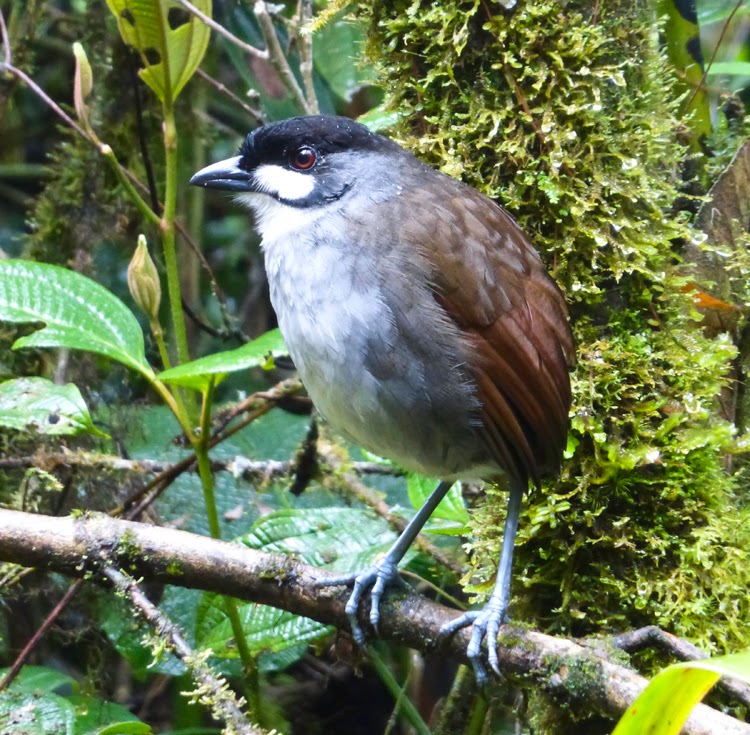
The Jocotoco Antpitta (Photos by Narca)

The Jocotoco Antpitta was only discovered in 1997, when ornithologist Robert Ridgely and a local guide were exploring the upper Chinchipe River drainage and heard an unfamiliar bird. They returned the next day with recording equipment, and out of the forest emerged a striking, large antpitta, unlike any known species.

The discovery of such a distinctive bird galvanized the conservation community, and the Fundación de Conservación Jocotoco was formed to safeguard the habitats of Ecuador's very localized, endangered and declining species, like the Jocotoco Antpitta. Thus, the mossy, cloud forest home of the Jocotoco Antpitta is now Tapichalaca Biological Reserve, the flagship reserve of the Jocotoco Foundation. We are privileged to visit.

The (very) wet montane habitat at Tapichalaca Reserve

The Jocotoco Foundation built an ecolodge, Casa Simpson, at the reserve and just off the main road between Vilcabamba and Valladolid. A substantial portion of the cost of staying at the lodge goes to fund their conservation efforts in Ecuador.

Inside Casa Simpson at Tapichalaca Reserve

The foundation took an additional step to help visitors see their famous resident: one of the forest guards from Tapichalaca went to Angel Paz's renowned farm near Mindo, to learn Angel's techniques for training antpittas to come to an offering of earthworms, part of their natural diet. The feeding technique worked, and today the Jocotoco Antpitta is a charming ambassador for Ecuador's conservation program.

After breakfast, we follow our guide Diego on steep, muddy trails for over an hour to the appointed feeding area. We arrive about a half hour late, and the antpittas have grown impatient. Instead of having to whistle or call for them, they are calling for us, and they've ventured a short ways down the trail in our direction!

First we see a fledgling, with its browner cap and less-distinct markings.

A young Jocotoco Antpitta

Diego puts out the day's helping of earthworms, and soon the adults come to feed, and to contemplate us.

Diego replenishes the larder

Waiting for the antpittas with Diego and Patricia 
(who also works for the Foundation)

We are completely bewitched, and sit quietly for perhaps an hour with our new acquaintances.

A handsome adult Jocotoco Antpitta, and its fledgling below

Eventually we continue down the trail, birding. Diego is an excellent guide. Another feeding station is set up a short distance beyond the first, and its diner is a White-throated Quail-Dove, another shy denizen of the forest.

White-throated Quail-Dove

We see one other antpitta, the Chestnut-naped, and Diego has saved a few worms for it as well.

A Chestnut-naped Antpitta, probably the Jocotoco's closest relative

A little farther down the trail, we look across the valley to a few palm trees, where the Jocotoco Foundation has put up nest boxes (casitas) for another local species in decline, the Golden-plumed Parakeet. Diego tells us that the parakeets are using the boxes, and as we watch, one flies in.

A Golden-plumed Parakeet at the entrance to its casita

To date, the Jocotoco Antpitta is known from only five locales, including one in the Cordillera del Cóndor on the Peruvian side of that range. The antpitta's entire population is estimated at probably no more than 700, but possibly as low as 150 individuals. It prefers wet montane forest with small streams, Chusquea bamboo thickets, and Silvery-leaved Cecropias, at an altitude of about 7000-9000 feet. Rare plants also flourish here, including 30 endemic species of orchids.

If you want to help the Jocotoco Foundation, you can make tax-deductible donations to them through their international partners like the Rainforest Trust, World Land Trust and American Bird Conservancy.