Showing posts with label Jocotoco Foundation. Show all posts

Wednesday, May 21, 2014

A Few Last Tidbits from Buenaventura Reserve

As we explore Buenaventura Reserve in Ecuador, the roars of howler monkeys rumble through the forest, Nine-banded Armadillos rummage through the leaf litter, and Two-toed Sloths clamber about the trees.

A foraging Nine-banded Armadillo bumbles into my feet, 
before realizing his mistake. (Photos by Narca)

Beautiful beetles...

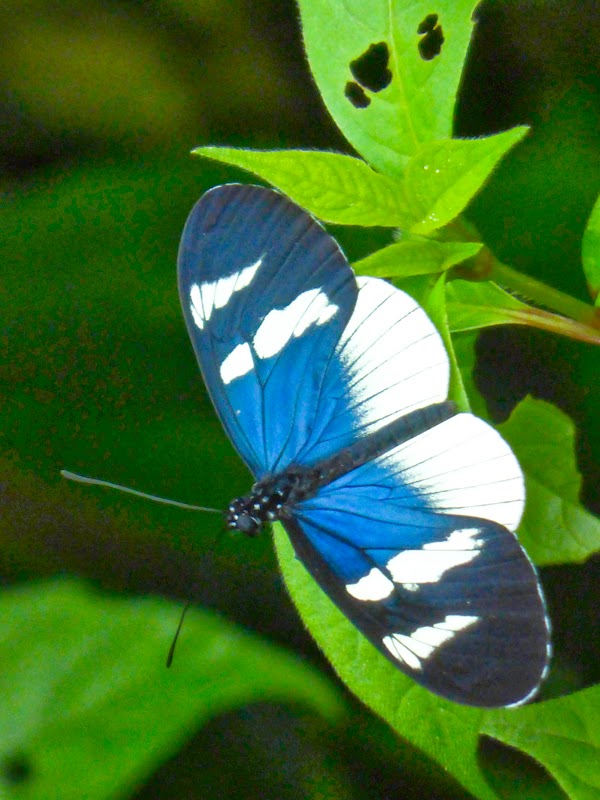
...and butterflies like this heliconid

...and this Scarlet Peacock enliven the trails.

The plants are also striking. 


A flowering bromeliad


Why would a plant have red tips on its leaves?? I'm sure that a botanist out there can answer that! Aldous Huxley would have credited it to the exuberance of nature.... and perhaps that's as good an answer as one derived from chemistry and the study of ecological adaptation! One feeds our knowledge; the other buoys our spirits.


Tuesday, May 20, 2014

Hummingbirds at Buenaventura Reserve

One of the finest hummingbird shows anywhere is here, on full and dazzling display from Buenaventura Reserve's front porch. The number of individuals is astonishing –– far too many for the birds to waste much time in skirmishing. We tally eleven species of hummers during our two days in the reserve, mostly at the feeders, although some like the Wedge-billed Hummingbird only appear for us in the surrounding forest.

Hummingbirds crowd around the megafeeders at Buenaventura Reserve.
(Photos by Narca)

An Andean Emerald, demure for a hummingbird!

Blurry photo of a Blue-chested Hummer, quite rare this far south

Many Brown Violetears frequent the feeders.

A tiny Green Thorntail female watches the commotion.

Male and female White-necked Jacobins, a common and widespread species

A striking male White-necked Jacobin

Little Violet-bellied Hummingbirds are among my favorites.

A slight turn shows this Violet-bellied's splendor!

World Land Trust operates a webcam which shows the hummingbird feeders at Buenaventura. I haven't yet found it working properly, but perhaps they will repair it soon –– it's well worth a look!

Monday, May 19, 2014

Back to Buenaventura's Birds

The treasures of Buenaventura don't end with its umbrellabirds. Among its other notable personages is the endangered El Oro Parakeet, endemic to a small region in southwestern Ecuador. Its range is thought to be only 60 miles long from north to south, by only 6 miles wide. Population estimates range from 250 to fewer than 1000 mature individuals.

The Jocotoco Foundation's Buenaventura Reserve is the stronghold for this species, in a region of highly fragmented habitat. Year-round, 60 parrots live in the reserve, with their numbers doubling seasonally as others return to the reserve from nearby areas.

Statue of El Oro Parakeet in nearby Piñas...
(Photos by Narca)

...and the Real McCoy, a mated pair of El Oro Parakeets

Lack of nest sites is thought to be a major threat to the parrots' survival, and the Jocotoco Foundation has put up nest boxes as a remedy. The parrots are occupying at least 15 of those nest boxes, and young have been fledging from the boxes since 2007.

We walk the reserve's trails and roads for two days. The birding is superlative. One of my favorites is the Club-winged Manakin –– we hear many, see a few, and none cooperate for the camera.

Here's a very small sampling of the reserve's birds!

Among many tanagers are the gorgeous Blue-necked...

and the locally abundant Lemon-rumped Tanager.

Striking Chestnut-mandibled Toucans are widespread in tropical America.

A more range-restricted Pale-mandibled Araçari, cousin to the toucan

Northern (Crested) Caracaras range all the way north into the US.

A Plumbeous Kite on her nest

 Pacific Horneros live only in western Ecuador and northwestern Peru, 
where they are common and conspicuous.

This Broad-billed Motmot shows more green on the belly than the similar Rufous Motmot.

The next post will bring you photos of other Buenaventura critters!

Sunday, May 18, 2014

Great Conservation News from Ecuador!

Ecuador's Jocotoco Foundation and the US-based Rainforest Trust have purchased a final, key property to "create a permanent refuge for the largest population of Andean Condors in the Northern Andes." Woolly Tapirs and Spectacled Bears also roam those hills.

 Andean Condor in Cayambe-Coca National Park
(Photos by Narca)

The newly-acquired Hacienda Antisanilla lies at the foot of the towering Volcán Antisana, and was one of the former private inholdings within the Antisana Ecological Reserve. These inholdings were being converted from forest to pasture and farmland; fires which started there burned into the reserve; illegal poaching based from the inholdings was rampant and difficult to control; and the most important watershed for the city of Quito was being undermined. Now effective preservation of both the reserve and Quito's watershed can be achieved.

Antisana Ecological Reserve is important not only in its own right, but also as a corridor between two national parks –– Gran Sumaco and Cayambe-Coca (more on Cayambe-Coca in a future post!).

Sign for Cayambe-Coca National Park at Papallacta Pass

Acquisition of this final property completes the effort to bring effective protection to 1.8 million acres of Andean and Amazonian ecosystems.

How needed was this reserve? All it takes is a two-day drive down the Andes from Quito south to the Peruvian border, to see just how much forest in Ecuador has already been lost. Along many stretches, for mile after mile, the country is denuded, and the tiny forest remnants are pitiful indeed. The few scattered reserves in the region are critically important.

If you'd like to read more about this project and other inspiring Rainforest Trust efforts in Bolivia, Peru, Brazil and Colombia, check out their latest newsletter.


Friday, April 11, 2014

Buenaventura's Umbrellabirds

Buenaventura Reserve protects a remnant patch of tropical cloud forest at about 3000 feet elevation. The cloud forest occupies a narrow zone, and most of the surrounding land holds seasonal tropical dry forest. Another jewel in the Jocotoco Foundation's system of reserves, Buenaventura is small, only about 6 square miles. Yet it protects 12 globally threatened species of birds, another 30 rare and regionally endemic birds, and notable mammals like the Ocelot, Mantled Howler Monkey, and Two-toed Sloth.

The reserve has been cobbled together since 1999 from patches of forest and old pasture land. The cleared areas are now being reforested, with the help and support of local communities. Growth of the reserve itself continues; the target size is about 20 square miles, or more than three times its current size. 


Remnant cloud forest at Buenaventura Reserve 
(Photos by Narca)

Welcome to Buenaventura Reserve!

Graceful Swallow-tailed Kites are frequent

Soon after we check into Umbrellabird Lodge (actually it's a more casual affair than "checking in" implies!), we ask about the famous umbrellabird lek, and learn that it's only about a 10-minute walk from the lodge. Young Leo is appointed to show us the spot. We learn that the umbrellabirds are most active early in the morning, but there's a chance that we can see them at dusk as well. And see them we do!

Umbrellabirds are big, very odd cotingas, an exclusively New World family. The male sports a long, inflatable wattle hanging from the center of his chest, used in courtship. They also boast an impressive crest, which shadows their faces and bills. During breeding season, the males gather under the forest canopy at a traditional lek to strut and perform before the females. Their low-pitched booming calls carry far through the forest.

Of the three species of umbrellabirds, two are in Ecuador. The Amazonian Umbrellabird is scarce and local; we met it in Podocarpus National Park. Buenaventura has the Long-wattled, a bird I have never seen before. It lives up to its name: the wattle can be as long as the whole body! The Long-wattled is also exceedingly rare.

A male Long-wattled Umbrellabird, with his astounding wattle

Looking up at the umbrellabird and his feathered wattle; 
the eye is actually dark –– here you're seeing reflected light.

For comparison, here's a male Amazonian Umbrellabird, with his short wattle and pale eye. From most angles, you'd also see a white patch at the base of his crest, making a great spotlight that's obvious even from a distance.

Male Amazonian Umbrellabird

The trail to the umbrellabirds is steep, but very well maintained, with a sturdy metal railing where it's needed. Buenaventura has adopted the best system I've seen for dealing with mud: the concrete steps have been poured into small tires (that untrustworthy toy size that rental and new cars sometimes use). The result is a stable, easy-to-use trail through otherwise slippery terrain. A far better use for that kind of tire than on an automobile!

Dusk catches us on the trail. Further exploration awaits another day!

Friday, March 21, 2014

Heading for Jorupe

Deciduous dry forest, Tumbesian style, at Jorupe Reserve
(Photos by Narca)

Jorupe Reserve in extreme southwestern Ecuador is only a stone's throw from Peru. One of the reserves under the aegis of the Jocotoco Foundation, Jorupe protects tropical deciduous forest, a habitat that has nearly vanished. Only about 1% of Ecuador's tropical dry forest remains intact.

The reserve is tiny (only about 2 square miles) but very important, protecting an endemic-rich habitat only found here and in neighboring northwestern Peru: the Tumbesian region. I find differing reports on the number of globally-threatened birds that occur in Jorupe, but it's about 20 species.

The reserve's boundaries are all too clear

The Jocotoco Foundation has its sights set on expanding the reserve a modest amount, and on regenerating degraded habitat within the reserve. Tropical dry forest can be more easily regenerated than tropical rainforest, as long as the seed bank is intact and the soils haven't completely washed away. (The regeneration of tropical dry forest was first demonstrated in northwestern Costa Rica.)

Recovery of degraded lands around Jorupe is being achieved through an ambitious project of revegetation. Within a 5-year period, more than 110,000 new trees have been planted.

Two of Jorupe's characteristic trees are these:

A muscular and much-admired ceiba tree, Ceiba trichistandra

Cecropia trees as a group are distinctive. There are more than 60 species of cecropias, and the northern Andes Mountains are the center for their diversity and evolution. Fast-growing, many of them pioneer both natural and man-made gaps within neotropical forests. Their fruits are highly sought by birds. Many of them harbor Azteca ants, which protect their host cecropia from herbivores.

A species of silver-leaved cecropia

Community outreach is part of the conservation effort at Jorupe, and it's winning staunch supporters among the local people. Ecotourism is also benefitting local communities like nearby Macará, a border town. The now-protected watershed also delivers clean drinking water to Macará.

If you wish to help the Foundation at Jorupe or any of its other reserves, you can make tax-deductible contributions to their work through the World Land Trust in the UK, the Rainforest Trust (the US partner of World Land Trust), or the American Bird Conservancy.

The Jocotoco Foundation has an on-site ecolodge, Urraca Lodge, which is beautifully constructed, and allows visitors to be right in the thick of the action.

The balcony of our cabin at Urraca Lodge; 
mixed flocks search the trees all around the cabin.

(Here's a tip, from our very fine guide at Jorupe, Leonidas: if you want to stay in Macará, the recommended hotel is Hotel los Arrozales. We spent a night in the reserve itself, and two nights at los Arrozales, which offered breakfast and air conditioning, and seemed to cater to businessmen.)

Birds like this Comb Duck may be found in the rice fields that occupy the short distance between Macará and the Peruvian border.

Now, against the background of this important conservation work, let's go birding at Jorupe!

Saturday, March 15, 2014

The Jocotoco Antpitta

We've come to Tapichalaca Reserve in southeastern Ecuador to meet a legend.

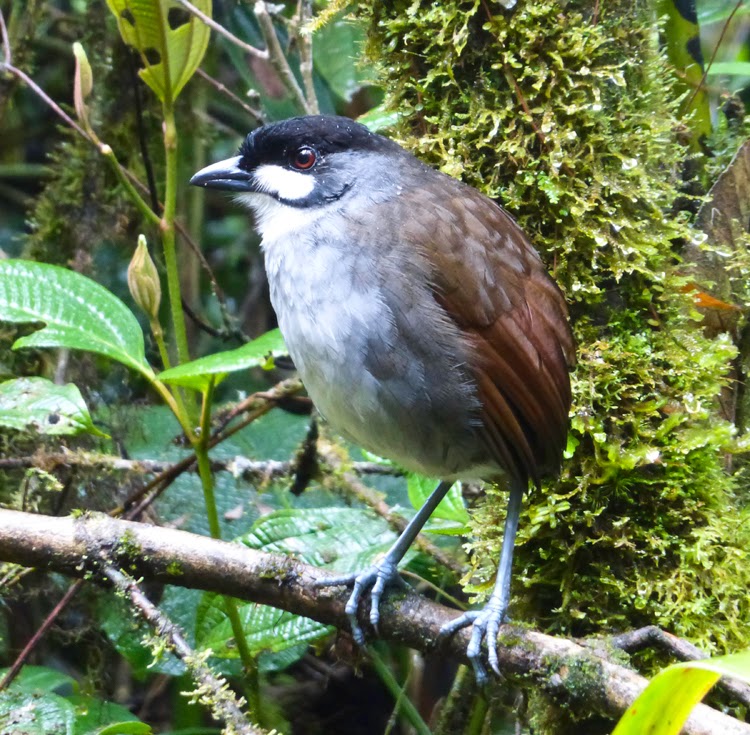
The Jocotoco Antpitta (Photos by Narca)

The Jocotoco Antpitta was only discovered in 1997, when ornithologist Robert Ridgely and a local guide were exploring the upper Chinchipe River drainage and heard an unfamiliar bird. They returned the next day with recording equipment, and out of the forest emerged a striking, large antpitta, unlike any known species.

The discovery of such a distinctive bird galvanized the conservation community, and the Fundación de Conservación Jocotoco was formed to safeguard the habitats of Ecuador's very localized, endangered and declining species, like the Jocotoco Antpitta. Thus, the mossy, cloud forest home of the Jocotoco Antpitta is now Tapichalaca Biological Reserve, the flagship reserve of the Jocotoco Foundation. We are privileged to visit.

The (very) wet montane habitat at Tapichalaca Reserve

The Jocotoco Foundation built an ecolodge, Casa Simpson, at the reserve and just off the main road between Vilcabamba and Valladolid. A substantial portion of the cost of staying at the lodge goes to fund their conservation efforts in Ecuador.

Inside Casa Simpson at Tapichalaca Reserve

The foundation took an additional step to help visitors see their famous resident: one of the forest guards from Tapichalaca went to Angel Paz's renowned farm near Mindo, to learn Angel's techniques for training antpittas to come to an offering of earthworms, part of their natural diet. The feeding technique worked, and today the Jocotoco Antpitta is a charming ambassador for Ecuador's conservation program.

After breakfast, we follow our guide Diego on steep, muddy trails for over an hour to the appointed feeding area. We arrive about a half hour late, and the antpittas have grown impatient. Instead of having to whistle or call for them, they are calling for us, and they've ventured a short ways down the trail in our direction!

First we see a fledgling, with its browner cap and less-distinct markings.

A young Jocotoco Antpitta

Diego puts out the day's helping of earthworms, and soon the adults come to feed, and to contemplate us.

Diego replenishes the larder

Waiting for the antpittas with Diego and Patricia 
(who also works for the Foundation)

We are completely bewitched, and sit quietly for perhaps an hour with our new acquaintances.

A handsome adult Jocotoco Antpitta, and its fledgling below

Eventually we continue down the trail, birding. Diego is an excellent guide. Another feeding station is set up a short distance beyond the first, and its diner is a White-throated Quail-Dove, another shy denizen of the forest.

White-throated Quail-Dove

We see one other antpitta, the Chestnut-naped, and Diego has saved a few worms for it as well.

A Chestnut-naped Antpitta, probably the Jocotoco's closest relative

A little farther down the trail, we look across the valley to a few palm trees, where the Jocotoco Foundation has put up nest boxes (casitas) for another local species in decline, the Golden-plumed Parakeet. Diego tells us that the parakeets are using the boxes, and as we watch, one flies in.

A Golden-plumed Parakeet at the entrance to its casita

To date, the Jocotoco Antpitta is known from only five locales, including one in the Cordillera del Cóndor on the Peruvian side of that range. The antpitta's entire population is estimated at probably no more than 700, but possibly as low as 150 individuals. It prefers wet montane forest with small streams, Chusquea bamboo thickets, and Silvery-leaved Cecropias, at an altitude of about 7000-9000 feet. Rare plants also flourish here, including 30 endemic species of orchids.

If you want to help the Jocotoco Foundation, you can make tax-deductible donations to them through their international partners like the Rainforest TrustWorld Land Trust and American Bird Conservancy.