Tuesday, October 25, 2011

Autumn Comes

What builds, what informs our sense of a place?

Fresh from yesterday's late-season rain, South Fork in the Chiricahua Mountains is entering autumn. Today I hike up the road, now inhabited by winter birds: the chittering small flocks of Chipping Sparrows, kinglets and titmice. The woodpeckers and sapsuckers are hammering industriously.

A Red-naped Sapsucker is back in his favorite winter tree.
(Photos by Narca)

A Mexican Jay hopes that a picnic is in his future.

A mob of Mexican Jays shadows me, swooping silently through the streamside cypress trees. Across the creek, a large mammal shuffles unseen uphill. Bear? A clumsy deer?

Arizona Sycamore (Platanus wrightii)

Sycamore leaves are rusting into a glorious orange against the deep blue Arizona sky, then dropping quietly into the creek.

The Lemonadeberry (Rhus trilobata) shades into coral and vermilion.

Silverleaf Oak (Quercus hypoleucoides)

A Silverleaf Oak's new leaves are red, too, but they still have a life of greening and photosynthesizing before they fall.

A late-blooming Red Columbine (Aquilegia triternata)

It is mid-day and the butterflies throng to the late-season flowers. Most are Variegated Fritillaries, but they are joined by a few blues, sulphurs, Arizona Sisters, ladies, Red-spotted Purples, one giant Two-tailed Swallowtail, and one of my favorites––a Red-bordered Satyr. Backlit in the sun, the oranges of the fritillaries and the sisters burn brilliantly in a visual echo of the autumn sycamore leaves.

An Arizona Sister (Adelpha eulalia) pauses on a sunlit cypress.

A Variegated Fritillary (Euptoieta claudia) nectars on an autumn composite.

All these details––all these particulars––tie us to the canyon, with its lichen-coated rhyolitic cliffs. These specific encounters create and deepen our felt sense of this place, in this particular time of its own long life. Autumn comes, after the big fire, after the healing rains. And here we are. Rugged Chiricahua hoodoos. Gallery forest of sycamore and cypress, sheltering life, winding between the high cliffs.

Friday, September 30, 2011

The Island of Streamertails

Are you thinking it's high time for an adventure? This next spring, after winter's deep snows and deeper thoughts, why not join me in Jamaica?

Jamaica: seabreezes, sun, misty forest, calypso––and those spectacular hummingbirds, the streamertails!

Red-billed Streamertails commonly visit Jamaican gardens.
(Photos by Peg Abbott)

We will base this week-long trip at two mountain eco-lodges, both surrounded by forest and shaded coffee plantations, and both sites lively with migrants and endemic Jamaican birds. Indeed, Jamaica has the greatest number of single-island avian endemics of any island in the West Indies––even more than its much larger neighbor, Cuba. According to World Wildlife Fund, Jamaica boasts more endemic birds than any other oceanic island in the world! That number is around 28, depending on just which splits are recognized. So, conjure up visions of Crested Quail-Doves, Jamaican Owls, Jamaican Euphonias, Jamaican Todies, Jamaican Spindalis and Yellow-billed Parrots––species found nowhere else on earth.

A delightful Jamaican Tody

World Wildlife Fund lists these endemics for Jamaica: 830 flowering plants and an additional 579 ferns; 27 reptiles; 20 amphibians; and 4 mammals including the hutia and 3 bats. Jamaica has over 500 species of endemic terrestrial snails! Of all the world's islands, Jamaica ranks 5th in the total number of endemic species it harbors.

It's a puzzle: why does Jamaica have such high levels of endemism?

Biologists have advanced several possible explanations. The island's habitats span a big elevational gradient, from sea-level coastal strand to elfin forest atop the main ridge of the Blue Mountains. Basic rock types range from limestone in the John Crow Mountains and the Cockpit Country, to igneous rocks and sedimentary shales in the Blue Mountains. Some plants are endemic to just a single limestone knoll! Conditions varied enough across the island that five distinct types of forest evolved. Complexity of soils and of vegetation supports, in turn, a more complex fauna.

Tree fern in the Hardwar Gap of the Blue Mountains

Location is also paramount. Jamaica was never connected to the mainland of Central America. But during the Ice Age when sea level was lower, three other large islands were exposed, and they provided stepping stones for island-hopping organisms. Just to the north of Jamaica, the very big island of Cuba also contributed to Jamaica's richness.

When we consider species richness, we often begin with impressive lists of the numbers of organisms for a particular place. But the true richness of a place transcends mere lists. It lies partly in the complex relationships between flora and fauna and soils, and partly in the lush, vivid sensory overload that tells us we are in the tropics.

Let's explore!

A fledgling Jamaican Owl ponders a human being.

Sunday, September 18, 2011

Rustler Park after the Burn

Recently Armando ("Mando") called a meeting in Rustler Park of 21 professionals from the US Forest Service, Arizona Game & Fish, and other agencies to assess the condition of Rustler after the Horseshoe Two Fire and to decide on the best way of encouraging its recovery. Reed Peters represented the newly-formed Friends of Cave Creek Canyon.

What they saw at Rustler surprised everyone. Normally after an intense crown fire, such as the one that roared through Rustler Park, the soil is sterilized by the high heat, and almost no plants grow for a very long time, possibly years. Even the mycorrhizae––the fungi associated with plant roots which allow seedlings to germinate––need to be reintroduced to sterilized soils. ((Usually rodents perform that service!) No one was prepared for the lush growth of wildflowers and ground cover which greeted everyone at Rustler Park, especially around the old campsites and the start of the Crest Trail.

How can botanists account for the unexpected growth? After puzzling over the situation, they settled on this theory: the backburn done about two weeks before the crown fire blazed through must have removed enough fuel that temperatures at ground level never got high enough to sterilize the soil.

Whatever allowed the strong recovery to take hold (and their theory sounds good to me!), botanists are seeing post-fire plants that they've rarely seen here, and the burnt aspen groves are surging with new growth. Reed was impressed with the number of Arizona (Ponderosa) Pines that still show green on the knoll above the campsites. Keep in mind that we've all been expecting the worst at Rustler and Barfoot Parks!

The Forest Service will remove dead trees in the campground, but will leave standing any that show green. Some of the small dead trees will be cut and left as firewood at the campsites. Workers will chip some trees, but not so many that the mulch interferes with the growth of new plants. The goal is to finish removing dead hazard trees by March, when Spotted Owls begin their nesting season. (Yes––a recent census of Spotted Owls in the Chiricahuas showed that not only do adults survive, they managed to fledge young this year as well!)

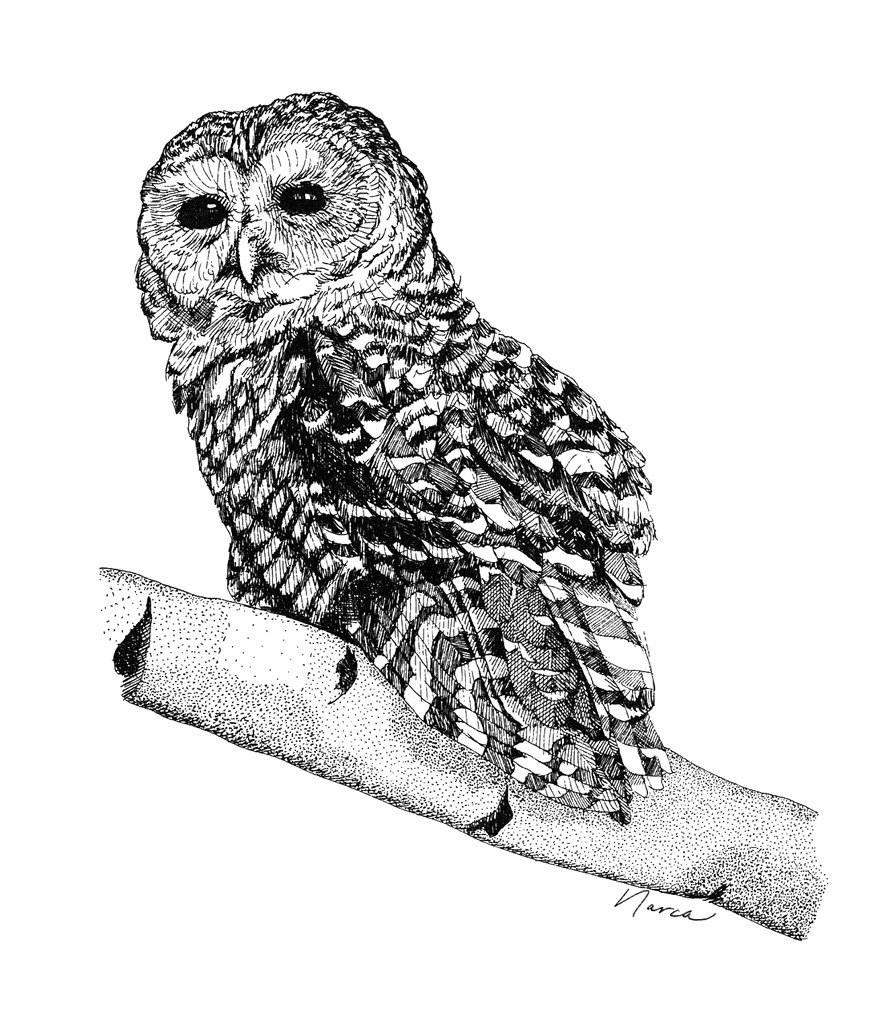
Spotted Owl (Pen & Ink by Narca)

Visitors returning to Rustler Park will, in time, see other changes. Ramadas are planned to shade the picnic tables, since so many trees were burned in the crown fire. Barfoot Lookout will be rebuilt on the same footprint. The bunkhouse will also be rebuilt. The Forest Service still has the original plans for the campground, which were developed in about the 1950s. People reviewing those plans came away very impressed with the skillfully designed layout and will respect the original work, figuring that the basic design can't be improved. Bathrooms, however, will be improved, especially to make them more accessible. Even brick-and-mortar bathrooms which are still standing will need to be rebuilt because the mortar was so weakened by the heat that they are a danger to the public.

New gates have been installed along various Forest roads, so that the roads can be closed easily whenever driving conditions are dangerous. A new route (a small road) to the Long Park gate is being considered, so that hikers will be able to bypass Rustler to reach the Long Park road even when the campground is closed.

Centaurea on the hike to Long Park (Photo by Narca)

Reed left the meeting (actually, was chased out by a hailstorm) feeling that the agencies' concern for Rustler Park and the Chiricahuas is genuine and obvious, and that great care is being taken in fostering the area's recovery, post-fire.

When will we be able to return to Rustler Park? Rumor is that the road to the top will open on September 24. I'll head up as soon after that as I can, and will post photos here of Rustler and Barfoot after the burn and after the summer monsoon. This news is encouraging!

Friday, September 9, 2011

Datura-Diving

Our friend John Roser, in his nightly patrols to see what's happening in his yard, discovered that giant Five-spotted Hawkmoths are visiting his massive flowering Datura. Since that discovery, several folks have held nightly vigils in John's yard, starting at dusk, to witness the show.

Sacred Datura unfurls its flowers each night. (Photos by Narca)

The Five-spotteds are very large hawkmoths, impressively bigger than the White-lined Hawkmoths that we frequently see here in the Chiricahua Mountains. They appear at dusk or shortly after, zeroing in on the opening white trumpets of Sacred Datura (Datura wrightii). Datura flowers grow up to 8 inches long, of a size to match the huge hawkmoths that they attract.

A Five-spotted Hawkmoth approaches a Datura flower. If you look carefully, you can see its proboscis beginning to probe the lower flower.

As the moth approaches a flower, it extends its extremely long proboscis into the bloom, then dives right in, wriggling past the pollen-bearing stamens into the flower's interior. There it turns around after a few moments and emerges, no doubt well-dusted in new pollen, which it carries to another flower.

The hawkmoth maneuvers into position, its proboscis now deep inside the flower.

Datura is in the plant family Solanaceae, and the big hawkmoth seems perfectly adapted to be its pollinator. The moth's larval food, likewise, is solanaceous plants. So here we have a good example of symbiosis or mutualism––the plant feeds the caterpillar, and when the caterpillar transforms into a giant adult, it insures the survival of the Datura by pollinating the flowers so that they can set seed.

In we go!

The Datura-diving moth quickly enters the flower and vanishes from sight.

The work of several major scientists has led to our better understanding the mutualism that binds flowers and their pollinators. Let's start with Darwin, who put forth the view that evolution (= change over time in the traits inherited by organisms) is driven by competition. However, in the view of Lynn Margulis, cooperation and mutual dependence play an even greater role. Dan Janzen focused closely on the theory of coevolution between flowering plants and their insect symbionts, based on the remarkable specializations shown by an Acacia and an ant, Pseudomyrmex ferruginea; he won the Crafoord Prize for his work in coevolutionary ecology. If the subject of pollination interests you, check out their work, as well as Gary Nabhan's book, The Forgotten Pollinators.

Yes, in the caterpillar stage these beasts are the infamous Tomato Hornworms. Since tomatoes and potatoes are also in the family Solanaceae, they fit the bill for caterpillar food quite nicely. Gardeners sometimes plant marigolds near their tomatoes to discourage the hornworms' interest.

Datura's common name, Sacred Datura, comes from its early ritual use by Native Americans. It is hallucinogenic, but a very dangerous hallucinogen. Adolescents who used the substance in initiation rites regularly died. The plant's compounds can take away vision, depress breathing, cause seizures, and bring on very high fever. Leave it to the hawkmoths!

Tuesday, August 30, 2011

Hope

Okay, this post departs from all my normal topics (unless we pull in Emily Dickinson's famous poem, "Hope is the thing with feathers..."). I've been thinking about hope, considering it, tasting it, turning it over.

For a long time I haven't let myself hope for anything. It seems an illusory, fraudulent wisp. It teases. It cheats. It doesn't look squarely at life. It rarely materializes. Better to stay with something solid. Better to stay centered on bedrock amidst the tumult of living, and let the daily tides wash past without hoping for any particular outcome. I tell myself, just breathe. Just stay with the flow of events, emotions, thoughts. Yes, the whole political scene in this country has gone to hell. Yes, species are winking out. Yes, close friends depart. Just breathe, just stay with it.

The downside: I'm feeling worn. Living without hope also erodes joy.

Today a powerful surge of hope welled up, and it didn't feel fraudulent. It felt charged with light and with healing.

My sister sent word of new research on MS (multiple sclerosis) which shows real promise of repairing the ravages of the disease by repairing the myelin sheath around the affected nerves. (My sister is among the many who are dealing with MS.) Click here for a link to that research.

Today's hope feels qualitatively different. It makes me think that we need to refine our language naming "hope." One name for the kind of hope at which we grasp––illusory, cruel, deceptive, fraudulent. And another name for the hope that surges up of its own volition and transforms us with an inner healing, coming as it does from the light at our core.

"Hope is the thing with feathers...."
(Acrylic of Sandhill Crane by Narca)

Thursday, August 25, 2011

The Fate of Sir Poopsalot

The greater Portal-Rodeo community will no doubt be delighted to learn that our famous tame Gambel's Quail, Sir Poopsalot, who lived the good life in Portal before hurling himself into someone's window, has been given to Gene Cardiff, a museum ornithologist. Gene is taking Sir Poopsalot to California, where he will become not just a specimen in a tray, but a full-fledged museum mount! That is a fitting conclusion to a short but celebrated life.

This Gambel's Quail is a stand-in for Sir Poopsalot. Think of him as an Elvis impersonator.

You should be able to visit Sir Poopsalot at the San Bernardino County Museum before too long (although they may not know him by that name!).

Monday, August 22, 2011

Huachuca Canyon with WFO

Our immersion in Huachuca Canyon, emerald-green and moist in this monsoon season, was a balm. One of the morning field trips at the Western Field Ornithologists' annual meeting explored this beautiful canyon, which is less often visited than neighboring Garden and Sawmill Canyons. Tony Battiste and Adam Searcy ably led the group.

At the mouth of Huachuca Canyon in the Huachuca Mountains
(All photos by Narca)

Some of the out-of-state folks had never seen an Elegant Trogon, so that species was a big highlight, as were a couple of juvenile Gray Hawks begging frequently and chasing after harried parents.

Immature Gray Hawk in Huachuca Canyon

Mary Gustafson pointed out a field mark on the young Gray Hawk that I hadn't been aware of: look at the tail bands. Those bands become increasingly thicker toward the end of the tail. This mark, Mary says, is reliable for separating young Grays from young Broad-wings.

Elegant Trogon male in Huachuca Canyon

A charming Canyon Tree Frog swam across the stream where it crossed the road. I don't see this amphibian very often. Its eyelids gleamed with glints of gold and copper.

Canyon Tree Frog in Huachuca Canyon

Overall the migrants still seemed low in number, but we did see a number of the resident "trophy" species of southeast Arizona: Sulphur-bellied Flycatchers, Hepatic Tanager. I saw a Violet-crowned Hummingbird, which appeared to be mobbing something at the back of an oak tree. They will mob Northern Pygmy-Owls, but if an owl was present, it didn't show.

A fair-sized Black Bear in Huachuca Canyon

The decision of how far to walk upcanyon was made for us: a big cinnamon-shaded Black Bear was lapping up berries at the side of the road and was loathe to abandon his feasting spot.


Out on the grasslands, singing Cassin's and Botteri's Sparrows gave everyone great views; a Greater Roadrunner was sunning in a clump of yuccas; and a gorgeous Painted Grasshopper added a burst of color to the scene.

A sunning roadrunner exposes the black bases of its back feathers to soak up more sun.

A spectacularly-marked Painted Grasshopper

As always, the WFO meeting was great fun. About 180 people attended, and both field trips and the science sessions were excellent. The annual meetings are renowned for the appearances of great rarities, with so many skilled field biologists scouring an area, and this was no exception. An Aztec Thrush wowed Homer Hansen's group in Garden Canyon.

Next meeting: Petaluma, California. Go! You'll love it.