Saturday, July 14, 2012

Carson Ghost Town

Some places call us repeatedly to return. For most of my family Lake City, Colorado, is such a place, starting with our grandparents in the late 1940s. 

The ghost town of Carson, with timberline just above (Photos by Narca)

Not too far from Lake City are the ruins of Carson, the ghost of a mining town that once thrived high in the San Juan Mountains, slightly below the Continental Divide. A miner, Christopher Carson, staked claim to the Bonanza King in 1881, and within a few years a town of 400 to 500 hardy souls had sprung up. The town's establishments included a livery stable, hotel and restaurants. Gold and silver briefly flowed, but winters proved too difficult, silver was devalued in 1893, and the town declined to extinction after the early 1900s. Its sheer inaccessibility presented a huge challenge to would-be residents.

Stampede to Timberline, Muriel Wolle's fascinating account of Colorado ghost towns, notes that Carson was built on an iron dike and therefore attracted far more than its fair share of lightning strikes!


Clumps of Mertensia are beautiful against the weathered gray wood.

Today, Carson is one of the best-preserved of Colorado's old mining camps, thanks to funding provided in large part by the federal government. New metal roofs have halted the disintegration of many of the cabins.

Yellow-bellied Marmots inhabit Carson today, as they no doubt did 100 years ago.

Beyond Carson, the wild San Juan Mountains beckon.

My grandparents spent most of their summers in Lake City, and the trip to Carson was a familiar one. Back then, the tiny town dump still held treasures of old purpled glass. Then, as now, the road up Wager Gulch to Carson required high clearance and 4-wheel-drive. When you reach Carson, you step back in time, to the era of oldtime, hardrock mining. What stories must haunt these log and plank walls!

Bighorn Sheep are among the rarer mammals of the San Juans. This bachelor group was spotted by our friend Jim Shiflett, between Creede and Lake City, during our June trip.

Today the high country around Carson is as exhilarating as ever. Lynx prowl the area. In most summers, the high mountain meadows are thick with flowers and butterflies. This year, after the lack of winter snow, a few flowers bloom, but it's only a ghost of the normal display.

Scarlet Gilia blooming at Carson

One of the yellow alpine paintbrushes...

... and its rosy relative, both at Carson

The only butterfly much in evidence is the Arctic Blue. On this cool, rainy day, they are hunkered down on the big composites, and little else is flying.

Arctic Blue clings to a composite on this chilly day.

Beyond Carson stretches a mountain wilderness. The old jeep road over the divide at Carson and down into Lost Trail Creek has degenerated into a simple trail. Barely accessible even in the 1950s and 1960s, Lost Trail was a lure for fly fishermen, because it still held a healthy population of native Cutthroat Trout. Our family would occasionally plan a camping trip to this wilderness, where, for shelter, we erected our tent within the log walls of a fallen-down cabin.

Today, while the others explore the road to the divide to see what shape it's in now, I walk alone through the spruce forest, past beaver ponds, and past the ruins of this cabin-with-a-view, which is perched above Wager Gulch and the distant valley of the Lake Fork of the Gunnison River.


Clouds shroud the high peaks. I see no Lynx, but this American Red Squirrel charms. 

American Red Squirrels are a close relative of Douglas Squirrel from the Pacific Northwest and Mearns' Squirrel from Baja California.

The songs of Hermit and Swainson's Thrushes spiral around me. Drumming woodpeckers duel. Mountain Chickadees and warblers feed their young. Mountain air is sharp and scented. How good to be back in the San Juans!

Friday, July 13, 2012

School for Thrashers

This morning a small Western Diamondback rattlesnake meandered into the yard. We knew a snake was nearby from the turmoil among the thrashers, cardinals, and Black-throated Sparrows. Nothing else stimulates such a flashing of wings and intense glaring.

A family of four Curve-billed Thrashers––both adults and their two fledglings––was especially emphatic. The adults seized the opportunity to teach their young a thing or two about the danger posed by snakes. Judging from the way the young joined the action, they are now well-schooled.

Curve-billed Thrasher protests a rattlesnake. (Photos by Narca)

A few minutes later a single Crissal Thrasher came in for a drink. This bird had no family in tow, but joined the general melée anyway!

A Crissal Thrasher joins the fracas.

Crissal Thrasher's best distinguishing marks––the chestnut undertail coverts and strong malar––aren't obvious here, but you can see the less-orange eye. To me they seem a little more slender and elegant than the Curve-billeds, with a slightly longer, slightly more curved black bill. With practice, you can learn to distinguish at a glance the subtle differences in proportions––but then confirm your impression by checking that malar mark and chestnut under the tail! Thrashers can pose identification challenges!

The business end of a Western Diamondback Rattlesnake, staked out and patiently waiting for a meal.


Saturday, June 30, 2012

Great Sand Dunes National Park

The fires raging in Colorado are reminding many of us of similar recent events on our home turf, and we feel great empathy for the current trauma there. Colorado was my home for many years during childhood, college years and young adulthood, and the scent of pine and the rush of mountain streams still take me home. Let's look for a bit at some of Colorado's natural jewels, starting with the Great Sand Dunes.

Dunefield of Great Sand Dunes National Park (Photos by Narca)

Hidden away in the San Luis Valley of Colorado are the sculpted sands of the tallest dunefield in North America: Great Sand Dunes National Park and Preserve. A recent scouting trip allowed me to explore this newest national park, in the fine company of our friend Jim.

Gnarly bark of a Rocky Mountain Juniper (Juniperus scopulorum)

The dune ecosystem is far more complex than I had realized. Cradled against the 14,000-foot Sangre de Cristo Mountains, the park's life zones range from alpine tundra above treeline, down through subalpine spruce forest, montane forest, pinyon-juniper woodland, the dunefield itself, the sand sheet and grassland surrounding the dunes, on down to the lowest elevations, which feature alkaline flats or "sabkha", and the riparian corridors and wetlands associated with seasonal creeks.

Sand dunes, we learned at the Gray Ranch in New Mexico, are a sponge for absorbing precipitation. Beneath the dunes, any impervious layer of rock or clay traps the water, so that trees can establish at lower elevations if their roots can reach water. Imagine what aquifer underlies the Great Sand Dunes!

Creeks flow into the dunes from the towering Sangre de Cristos––mainly Medano and Sand Creeks. These creeks are shallow, surging, and seasonal. Children and adults delight in playing in the cool waters. In this extreme year of drought and heat, very few wet spots are showing at the surface in late June. But at a slightly lower elevation, the waters sponged up by the dunes are still being released slowly, feeding the wetlands where American Avocets and Killdeer breed.

The dunefield at dusk

The sand sheet with its grasslands surrounds the dunefield. In this region vegetation has stabilized old dunes, so that they no longer shift and now support thriving grasses and shrubs like Rabbitbrush (a fantastic magnet for butterflies and other insects when it blooms).

This trip, we camp at Pinyon Flats, as shadows grow long on the dunes. Smoke from the distant Little Sand Fire, burning to the northwest of Pagosa Springs, blurs the western mountains but doesn't quite reach us here.

Next morning, we find Clark's Nutcrackers and bright flowers along shady Montville Nature Trail. By all reports the winter has been exceedingly dry, and certainly the Sangre de Cristos don't carry their usual mantle of snow and ice––what was there has mostly melted. Yet I am used to desert conditions, and am surprised to find a fine variety of wildflowers and busy insects, in so dry a year.

Wyoming Paintbrush (Castilleja linariifolia)

Quaking Aspen (Populus tremuloides)

After hiking the nature trail, we drive to the Point of No Return and explore the nearby dunes. The whisk marks of kangaroo rats' tails and the miniature tractor-prints of big beetles pattern the sand.

Vesper Sparrows and Green-tailed Towhees both find the region much to their liking. They are at the peak of nesting season, and the air rings with their songs.

A hefty Vesper Sparrow on territory

A Green-tailed Towhee throws every ounce of strength into broadcasting his song.

Even in the grassland near the dunes, flowers still manage to bloom, beautifully.

Hall's Penstemon (Penstemon hallii)

In wetter years, Prairie Sunflowers (Helianthus petiolaris) carpet the grassland. Now only a scattered few are blooming.

Scarlet Gaura (Gaura coccinea) is a familiar, widespread species.

Rocky Mountain Beeplant (Cleome serrulata) is spectacular!

This native Wavyleaf Thistle (Cirsium undulatum) is irresistible to insects.

A night-blooming Cutleaf Evening Primrose (Oenothera coronopifolia) hasn't yet faded with the coming of day.

Insects also catch our eye, including this lovely dragonfly.

OK, Doug and Bob, this one is for you!
And indeed, Doug Danforth tells me this is a female Variegated Meadowhawk (Sympetrum corruptum)––thanks, Doug!

An endemic tiger beetle roams the dunes, but seeing that gorgeous insect will have to wait till the next trip!

Dark, heavy sand grains of magnetite form patterns on the dune.

Another fantasy dances in my mind: imagine spending the night up on those dunes, when they are flooded in moonlight, or dark with a field of stars blazing overhead. We talk to one young couple who did just that. They say that sand is in all their gear and clothes, but how worth it for the experience!

Monday, June 11, 2012

Fledgling Trogons!

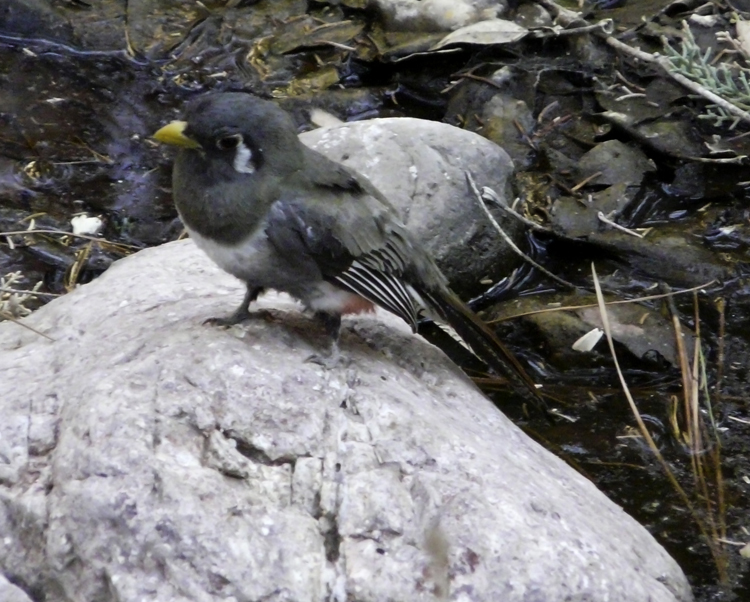
Wow––6 trogons in South Fork this morning! My first glimpse was of a plump bird, breast on, perched on a creek boulder. That breast showed a big white crescent, framed above and below by dark, and my first thought was, surely not a Ring Ouzel! Surely not, indeed. Through binoculars it resolved into a fledgling trogon with darker-than-normal feathers framing the big white breast crescent.

Later I saw a second fledgling, accompanied by an adult male and possibly the sibling of the first, though they were separated by about 100 yards. This second youngster didn't look as dark below the chest band, and allowed a closer approach. Its tail, while showing copper, wasn't as bright as the tail of the first fledgling. Here it is:

Fledgling Elegant Trogon, front and back (Photos by Narca)


Up at the trailhead, two male trogons were contesting territorial rights. The younger male foraged, plucking insects from spider webs. Mostly the action was quiet, and the two even perched side by side for a while. But all it took was the arrival of a female trogon, and suddenly the two males were grappling mid-air!

Two male Elegant Trogons are sizing up each other.

The older male is warning away the younger with a bit of tail-flipping, prior to combat.

The underside of the tails of these two birds reveals their age difference: the bird on the left shows the heavier barring of a one-year-old male in his first summer of life. The bird on the right shows much finer barring under the tail––the pattern of an older male. The year-old bird also shows an anomalous white feather within the green of the breast. If that pattern holds true through future molts, we should be able to identify this individual in years to come.

Interestingly, none of these three adult males was the same as the male at the known nest. That male (often seen near the bridge) has an anomalous dark feather within the white breast band. He also has a mate, so it appears that at least 8 trogons, including the two fledglings, are in lower South Fork. It also appears that the trogon census missed some! Possibly running it in May instead of June, as customary, resulted in the census's low figure of 8 individuals for the entire Cave Creek drainage. (The June counts sometimes record fledglings; one year on the count a trogon fledged right before our eyes, and landed at our feet, stub-tailed and blinking at the world.)

Other fledglings were also out and about: young Bridled Titmice, young Painted Redstarts. The Painted Redstart fledglings are at that stage when birders unfamiliar with the plumage sometimes think they are seeing a Slate-throated Redstart. Today one of the young redstarts was a black-and-white blur, not yet showing a smidgeon of red, flycatching in the gloom beneath the big willow at the South Fork bridge.

Even a young Northern Goshawk came roaring in, perched briefly, glared at me, and flew off, kek-kek-kekking. A word of advice to the young trogons––¡Ojo!––keep your eyes open! 


Early morning in South Fork


Friday, June 8, 2012

Look Who Came to Dinner

Gila Monster in Portal (Photos by Narca)

Gila Monsters have been uncommonly common this season! This is the fourth for me: two in Guadalupe Canyon, and two here, close to Portal. Quite a treat!


Wednesday, June 6, 2012

Aahh, the Benefits of Exercising...

...in South Fork!
Elegant Trogon male (Photos by Narca)

For one, you may glimpse an Elegant Trogon descending to the creek bottom for a drink. This male was hover-sipping from a rill of water spilling between boulders, just as he would hover before a tree to pluck fruit.


For another, you might find new blooms of Butterfly Milkweed...

Butterfly Milkweed, Asclepias tuberosa

...or of Scarlet Penstemon.

Scarlet Penstemon, P. barbatus

For a third, an Apache Fox Squirrel could scamper across your path. In the US, this mammal lives only in the Chiricahua Mountains.

Apache (or Mexican) Fox Squirrel

A Variegated Fritillary could cross your path...

Variegated Fritillary, Euptoieta claudia

As the poet Rumi wrote, "The breeze at dawn has secrets to tell you. Don't go back to sleep. You must ask for what you really want. Don't go back to sleep.... The door is round and open. Don't go back to sleep."

Now, that was a good walk, was it not?

Tuesday, June 5, 2012

The Transit of Venus

Rick and Vicki Beno graciously invited the Portal-Rodeo community to their home to observe today's transit of Venus, with the aid of Rick's very fine telescopes. It was truly a marvel to see the phenomenon so well.

From our perspective on Earth, Venus was transiting across the face of the Sun. The view through the scope was heavily filtered to prevent any damage to people's eyes. (It's important not to look directly at the Sun!) Here is how it appeared this afternoon: who would have guessed it would be possible to digiscope the event?!

Transit of Venus across the Sun
(Photos by Narca, thanks to Rick and his equipment)

See the solar flares around the rim?

Pairs of Venus transits happen between long gaps of 121.5 and 105.5 years, with the entire cycle repeating every 243 years. The first transit of the current pair happened on 8 June 2004, and the first of the next pair of transits won't occur till December 2117, so not within any of our lifetimes.

The Venus transit was important historically because it gave early astronomers their best shot at calculating both the distance of Earth to the Sun, and also the dimensions of our solar system. The very first transit of Venus to be observed was in 1639 by Jeremiah Horrocks. Then Edmond Halley, of Halley's Comet fame, wrote of the scientific importance of observing a transit of Venus, but he didn't live long enough to do it himself. When the next pair of transits occurred in 1761 and 1769, scientists cooperated in making observations from many points on the globe. The first attempt in 1761 was partly successful, and set the stage for a much better effort in 1769, when even the famous Captain Cook participated.

Now astronomers are hoping to refine their methods of searching for extrasolar planets as they track and observe today's transit of Venus.

Watching the transit of Venus with Rick Beno, and with the backdrop of Cave Creek Canyon

It's no surprise that a little community of astronomers has found a home under the dark skies of the Chiricahua Mountains. Remember Comet Hale-Bopp in 1997? At its brightest here, the comet's tail covered as great an arc, roughly, as the Big Dipper. These starry skies are magnificent, and the astronomers who have settled here contribute a very fun dimension to the region's character.

Thank you, Rick and Vicki, for a fascinating opportunity!